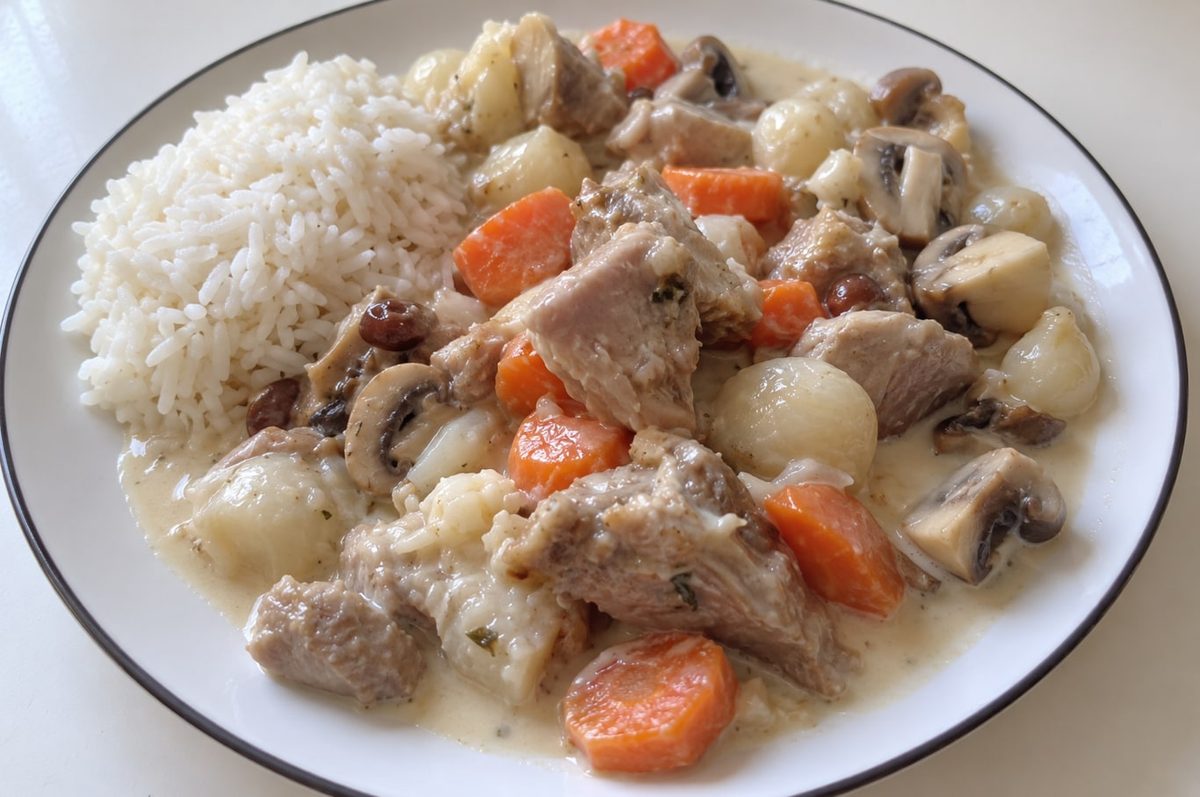
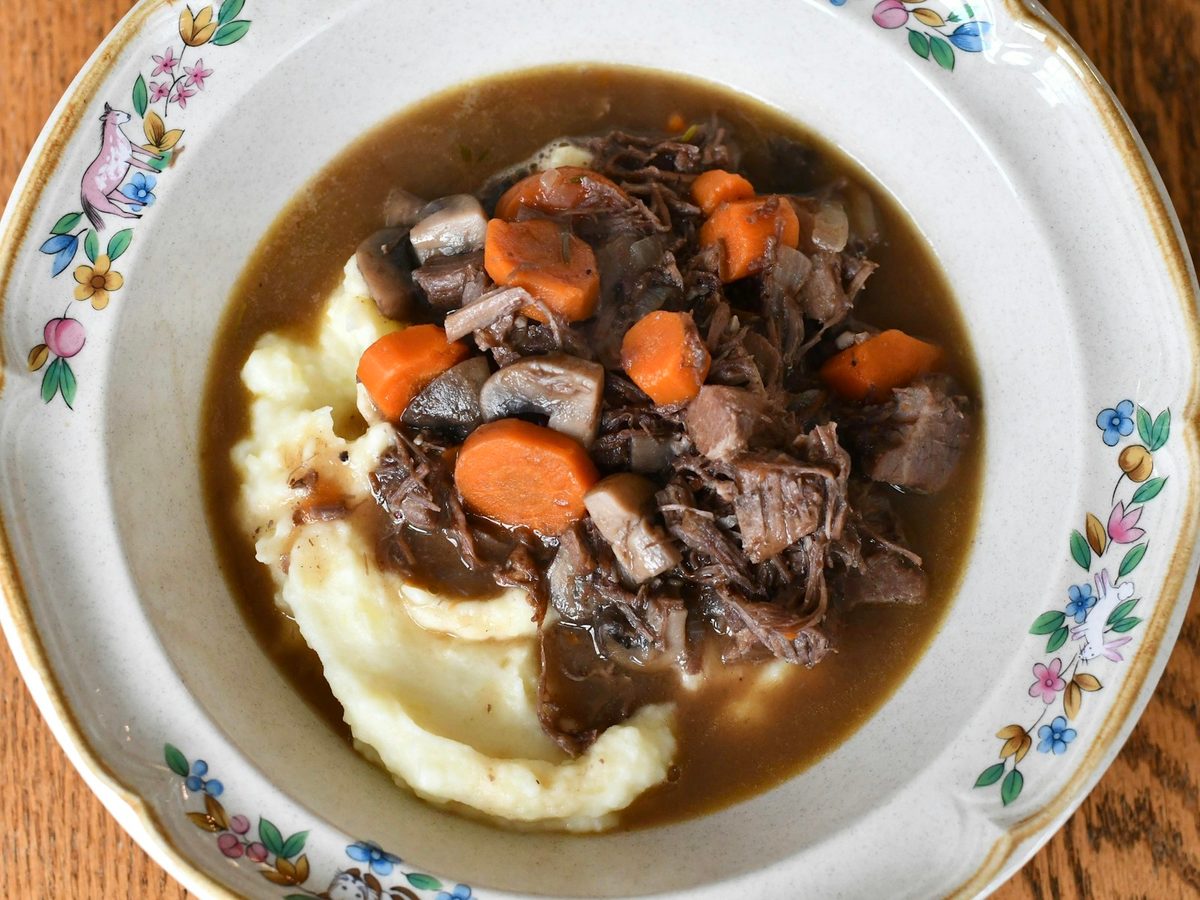
Three cuts of beef simmered for hours with carrots, leeks and turnips, served in two courses: the clear broth first, then the meat and vegetables with mustard and coarse salt. Made with Canadian blade roast, cross-cut shank and short ribs.
I didn't grow up with pot-au-feu, even though for many French families it's the winter Sunday pot. So I come to it the way a lot of readers here will: as a French classic to learn in a Canadian kitchen, with Canadian cuts. It's exactly the kind of dish I want to keep cooking here, slow and generous, with leftovers for days.
Shopping for it in Canada takes a little translating. No meat counter here sells a ready-made pot-au-feu assortment, so you build it yourself from three supermarket cuts, and the "turnip" in the produce aisle is often a rutabaga, which tastes much sweeter in the broth. Once you know that, the rest is just water, time and a big enough pot.
Pot-au-feu is beef and vegetables simmered for hours and eaten in two courses: a bowl of clear broth first, then the sliced meat and vegetables with mustard, coarse salt and cornichons.
Three cuts, three textures
The point is to mix cuts: one that holds together in slices, one full of gelatin and one with fat, plus marrow bones. French butchers sell paleron, gîte and plat de côtes ready for pot-au-feu. Here, blade roast, cross-cut beef shank and thick braising short ribs from the supermarket counter do the same job.
Which turnip, and how big a pot?
In much of Canada, the big yellow root labelled "turnip" is a rutabaga. French navets are small white turnips with a purple top.
The meat, bones and 4 L of water need a stockpot of 8 L or more. A 5 or 6 L Dutch oven can't hold it all; with one, halve the recipe.
Walmart sells 12-quart (11.4 L) stockpots from Tramontina and Home Trends, and Canadian Tire has an 11 L stainless pot from H2K.
Keeping the broth clear
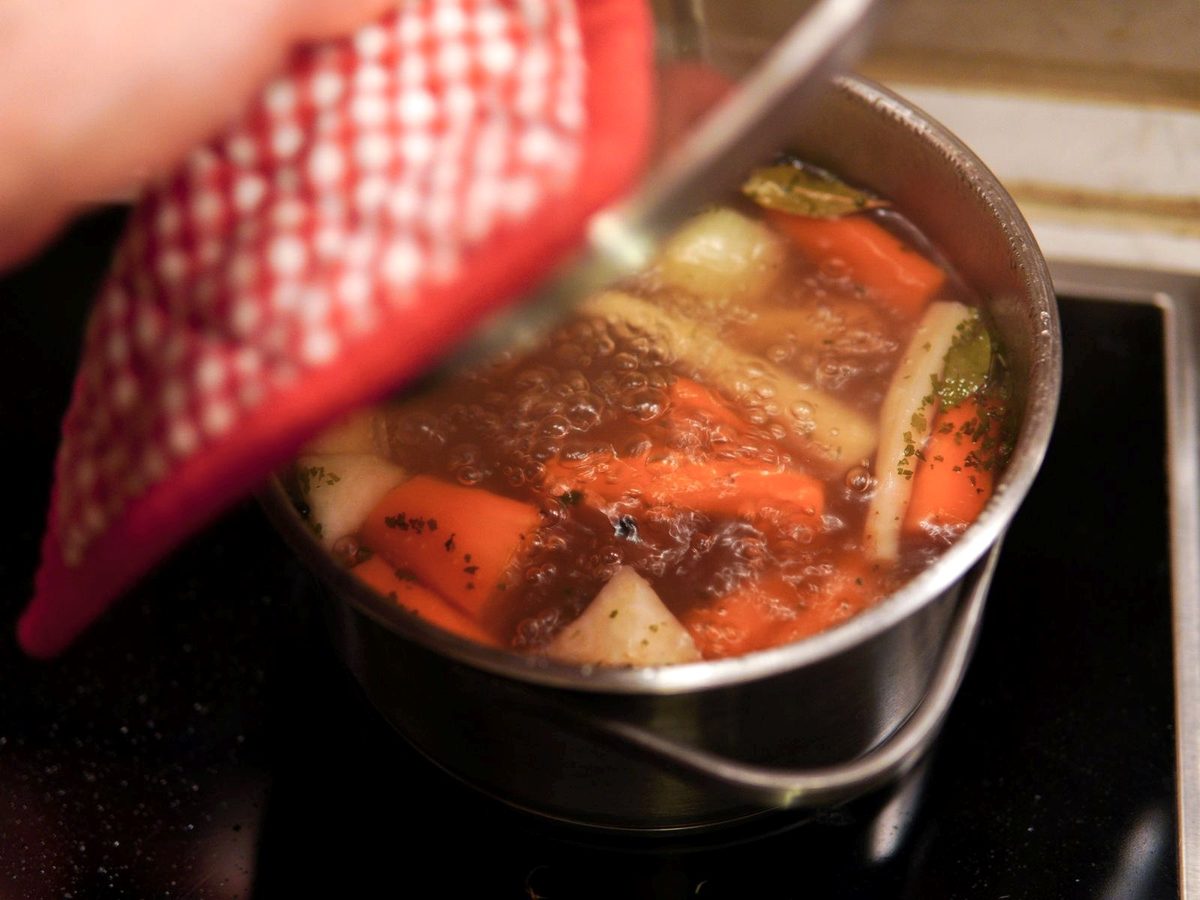
Start the meat in cold water, skim carefully, and never let it boil. A bare simmer gives a clear, golden broth; boiling makes it cloudy and the meat stringy.
Making it in Canada
The 3 French ingredients, and what to buy for them in Canada.
Paleron, gîte, plat de côtes→Blade roast, cross-cut beef shank (osso buco), braising short ribs
Blade is marbled with a seam of gelatin, so it stays moist and still slices. Shank gives the broth body, and short ribs bring the fat. Ask for thick, bone-in short ribs cut between the bones, not thin flanken strips cut across them, which fall apart in three hours.
🛒 Metro and Loblaws sell boneless blade roast. Cross-cut shank is labelled "Osso Buco" (Metro). Loblaws sells "braising short ribs", the thick cut.
Navets→Small white turnips with a purple top
Rutabaga, the yellow "turnip", is sweeter and denser and can take over the broth. If it's all you find, use half the weight of the turnips, about 200 g, peeled and cut in chunks.
🛒 Ask the produce counter for white turnips, not rutabaga.
Os à moelle→Beef marrow soup bones
Pick pieces cut across the bone, about 5 cm long, with marrow showing at both ends. Wrap the ends in cheesecloth or dip them in coarse salt so the marrow stays in.
🛒 Real Canadian Superstore and Metro sell beef marrow soup bones by weight (Superstore packs average about 0.73 kg). Cheesecloth is in the canning aisle at Canadian Tire (Bennett) and at Walmart (Pillsbury).
Good to know: Ask the meat counter to tie the blade roast so it holds together in the pot.
Ready to cook?
Pot-au-Feu
Three cuts of beef simmered for hours with carrots, leeks and turnips, served in two courses: the clear broth first, then the meat and vegetables with mustard and coarse salt. Made with Canadian blade roast, cross-cut shank and short ribs.
Prep time
30 min
Cook time
3 hr 45 min
Total time
4 hr 15 min
Servings
6
Ingredients
Original recipe: 6 servings.
Instructions
Start in cold water. Put the blade roast, shank and short ribs in a stockpot of at least 8 L and cover with the cold water. Bring slowly to a simmer over medium heat, about 30 minutes, then skim off the grey foam for 15 minutes.
Season and simmer. Add the charred onion, bouquet garni, salt and peppercorns. Simmer very gently, partly covered, for 2 hours: a bubble should break the surface only every second or two.
Add the vegetables. Add the carrots, turnips and leeks and simmer 1 hour more, until a fork slides into the meat without resistance and the carrots are tender to a knife.
Cook the marrow bones. In the last 20 minutes, lower the marrow bones into the pot.
Cook the potatoes. Meanwhile, boil the potatoes separately in salted water for about 20 minutes, until a knife slides in. Cooking them in the pot would cloud the broth.
Serve in two courses. Strain some broth into bowls and serve first, with toast. Then slice the meat and serve it with the vegetables, potatoes, marrow bones (the marrow is spread on toast with coarse salt), mustard, cornichons and coarse salt.
Equipment
Staub 5.5 L round cocotte: For a half batch only: a 5–6 L cocotte holds a bare simmer for three hours. The full recipe needs a stockpot of 8 L or more.
Amazon links are affiliate links: as an Amazon Associate I earn from qualifying purchases, at no extra cost to you.
Notes
To make it in a 5 or 6 L Dutch oven, halve everything, including the water.
Keeps 4 days in the fridge; the broth keeps 3 months in the freezer. Reheat leftovers until steaming: Health Canada's safe minimum for reheated leftovers is 74°C (165°F).