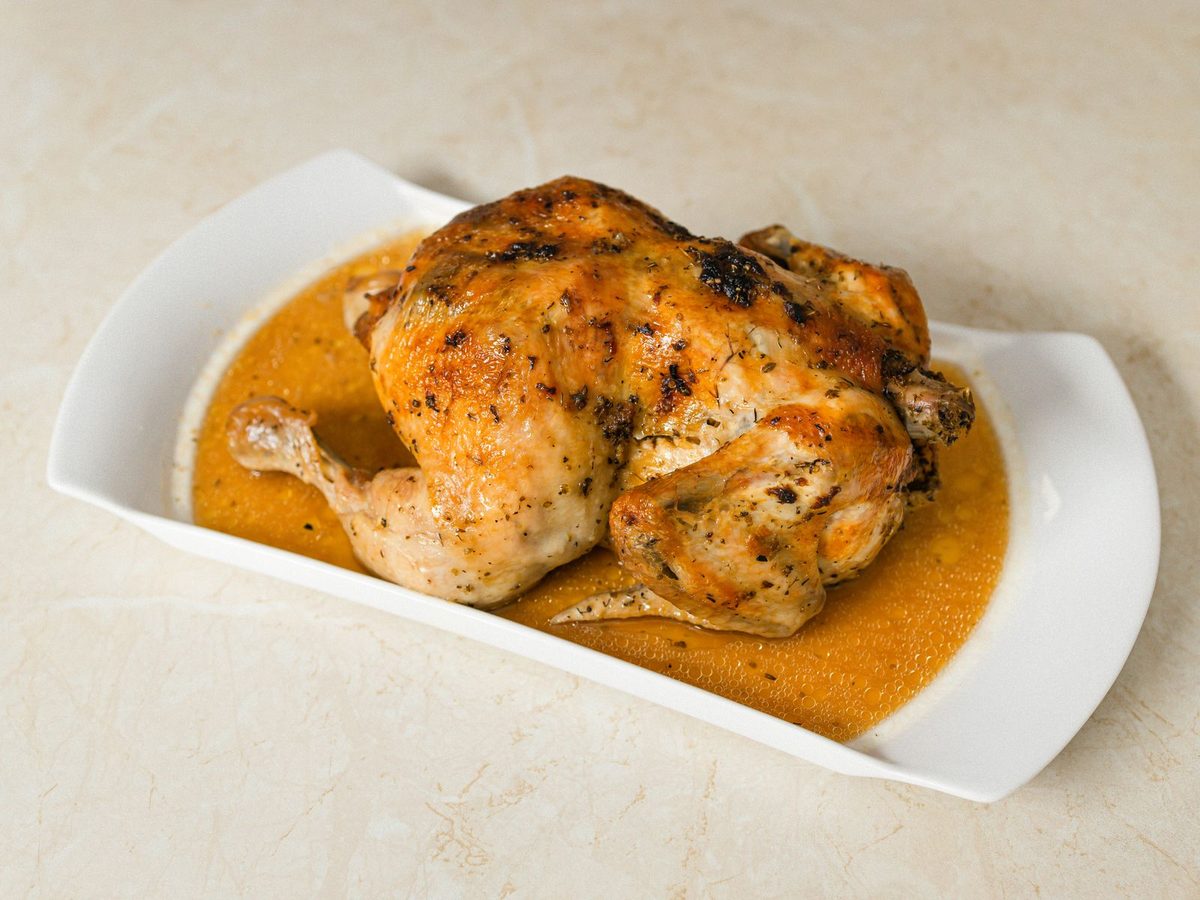
A whole chicken rubbed with butter and thyme, roasted until the skin is crisp and golden, with a quick pan jus made from the drippings. A Sunday classic in France, and a relaxed Thanksgiving main for a table too small for a turkey.
If I could only cook one French meal in Canada, it would be this one: a chicken, butter, thyme and a hot oven, and the kitchen smells like a Sunday in France. It's also my pick for Thanksgiving when the table is too small for a turkey.
Carved at the table, with its own jus
The classic French Sunday lunch: a whole chicken roasted with butter, carved at the table and served with its pan juices, potatoes or a green salad, and bread to wipe the plate. Markets sell them hot from the rotisserie on weekend mornings, but a home-roasted one takes about ten minutes of actual work.
Which chicken to buy here?
The chicken itself is the difference. A French poulet fermier is a slow-growing breed raised outdoors, with firmer meat and more flavour. Most Canadian supermarket chickens grow faster and are chilled in cold water after slaughter, so the skin goes into the oven damp and struggles to crisp.
Buy an air-chilled chicken when you can. The words are printed on the label, and the skin browns far better.
Pick one around 1.6–1.8 kg. Bigger birds dry out at the breast before the thighs are cooked.
Check the thigh, not the breast
A thermometer is the one tool worth having for this. The breast cooks first and will read done long before the leg is, so always measure in the thickest part of the thigh.
Making it in Canada
The 2 French ingredients, and what to buy for them in Canada.
Poulet fermier Label Rouge→Air-chilled whole chicken, 1.6–1.8 kg
French farm chickens are slow-growing and raised outdoors, so the meat is firmer and tastier. An air-chilled bird isn't the same breed, but it hasn't soaked up chilling water, so the skin crisps and the meat tastes more of chicken. A water-chilled bird still works: dry it well and salt it the night before.
🛒 President's Choice Air Chilled Whole Chicken (about 1.7 kg) is sold at Loblaws and Real Canadian Superstore, and at Maxi in Quebec. Maple Leaf Prime whole chicken, also labelled air-chilled, is listed at Voilà (Sobeys). In Quebec, "poulet de grain" on a label is about the feed, not the chilling, so still look for "air-chilled".
Fond de volaille→No-salt-added chicken broth
Only if you want a richer jus than water gives. No salt added keeps the jus from turning salty as it reduces.
🛒 Campbell's No Salt Added Chicken Broth, 900 mL carton, at Walmart and Voilà (Sobeys).
Good to know: If you can only find a water-chilled bird, don't skip the overnight salting in the tip: it does the most for that kind of chicken.
Ready to cook?
French Roast Chicken
Poulet rôti
A whole chicken rubbed with butter and thyme, roasted until the skin is crisp and golden, with a quick pan jus made from the drippings. A Sunday classic in France, and a relaxed Thanksgiving main for a table too small for a turkey.
Prep time
15 min
Cook time
1 hr 25 min
Resting time
15 min
Total time
1 hr 55 min
Servings
4
Rest the chicken under foil so the juices settle before carving.
Ingredients
Original recipe: 4 servings.
Instructions
Get the chicken ready. Take the chicken out of the fridge 30 minutes before roasting. Heat the oven to 200°C (400°F) with a rack in the lower middle. Pat the chicken dry all over with paper towel, inside and out.
Season it. Rub the butter over the skin, then season it all over and inside with the salt and pepper. Put 2 sprigs of thyme and one half of the garlic head in the cavity. Tie the legs together with kitchen string if you have some.
Set up the pan. Put the onions, the other garlic half and the rest of the thyme in a roasting pan or baking dish just bigger than the chicken. Set the chicken on top, breast up, and pour 125 mL of the water around it.
Roast. Roast 75–90 minutes, basting with the pan juices every 20 minutes, and start checking at 70 minutes. If the pan dries out, add a splash of water so the juices don't burn. It's done when the leg moves loosely in its joint and the juices from the thigh run clear. Check with a thermometer in the thickest part of the thigh, not touching the bone. Health Canada's safe minimum for whole poultry is 82°C (180°F).
Rest. Lift the chicken onto a board, tipping the juices from the cavity into the pan. Cover it loosely with foil and rest 15 minutes.
Make the jus. Spoon off most of the clear fat, leaving the brown juices. If your pan can go on the stove, set it over medium heat; if not, scrape everything into a small saucepan. Add the remaining 125 mL water, scrape up the browned bits and simmer 2–3 minutes, pressing on the onions and garlic. Strain into a jug and add any juices from the board.
Carve and serve. Cut off the legs and split them at the joint, then slice each breast off in one piece and cut it in two. Serve with the jus.
Notes
For potatoes in the same pan, add 750 g halved baby potatoes around the chicken after 30 minutes and turn them in the juices each time you baste.
If the skin is browning too fast before the thigh is done, cover the breast loosely with foil.
Leftover chicken keeps 3 days in the fridge. Simmer the carcass with an onion and a carrot for a quick broth.