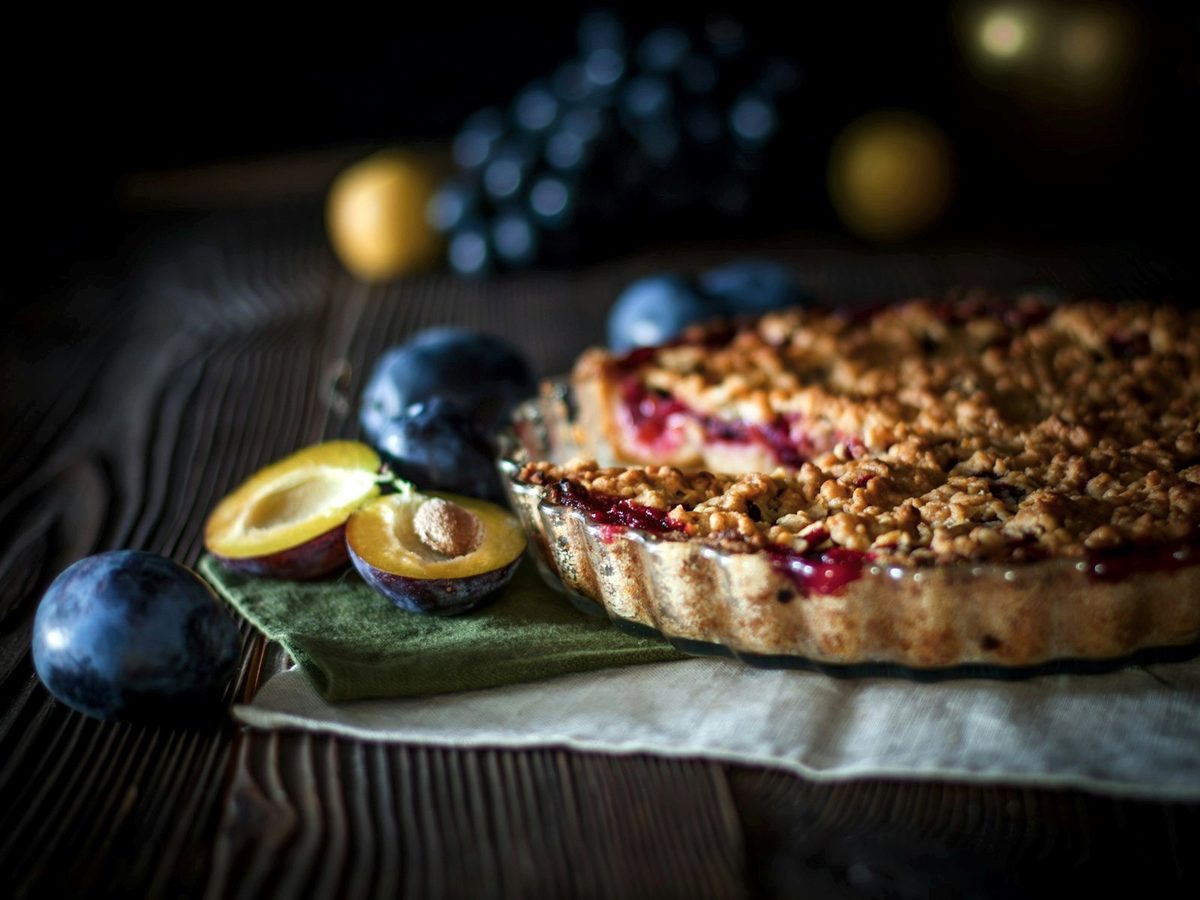
A butter shortcrust filled with apple wedges, baked until they soften, then covered with a vanilla custard of eggs, cream and sugar and baked until just set. The Alsatian apple tart, made with Golden Delicious apples and Canadian 35% cream.
The apple tart I grew up with in Alsace isn't the one in Paris bakery windows. Ours has no compote and no glaze: apple wedges go into the pastry and bake until they soften, then a custard of eggs, cream and sugar is poured around them and baked until it barely sets. It comes out soft and rich, closer to a flan with apples in it than to a neat fruit tart.
Here, the custard is the easy part, because all it needs is eggs and 35% whipping cream, and every Canadian dairy case has that. The apples change more: the sharp Reine des Reinettes French cooks bake with isn't sold here, so my pick is Golden Delicious, the same variety French bakers use, with a squeeze of lemon if they taste flat. The one shortcut I'd skip is a frozen pie shell: in this tart you taste the butter in the pastry, and the Tenderflake shells in most freezers have none.
Custard tart or compote tart?
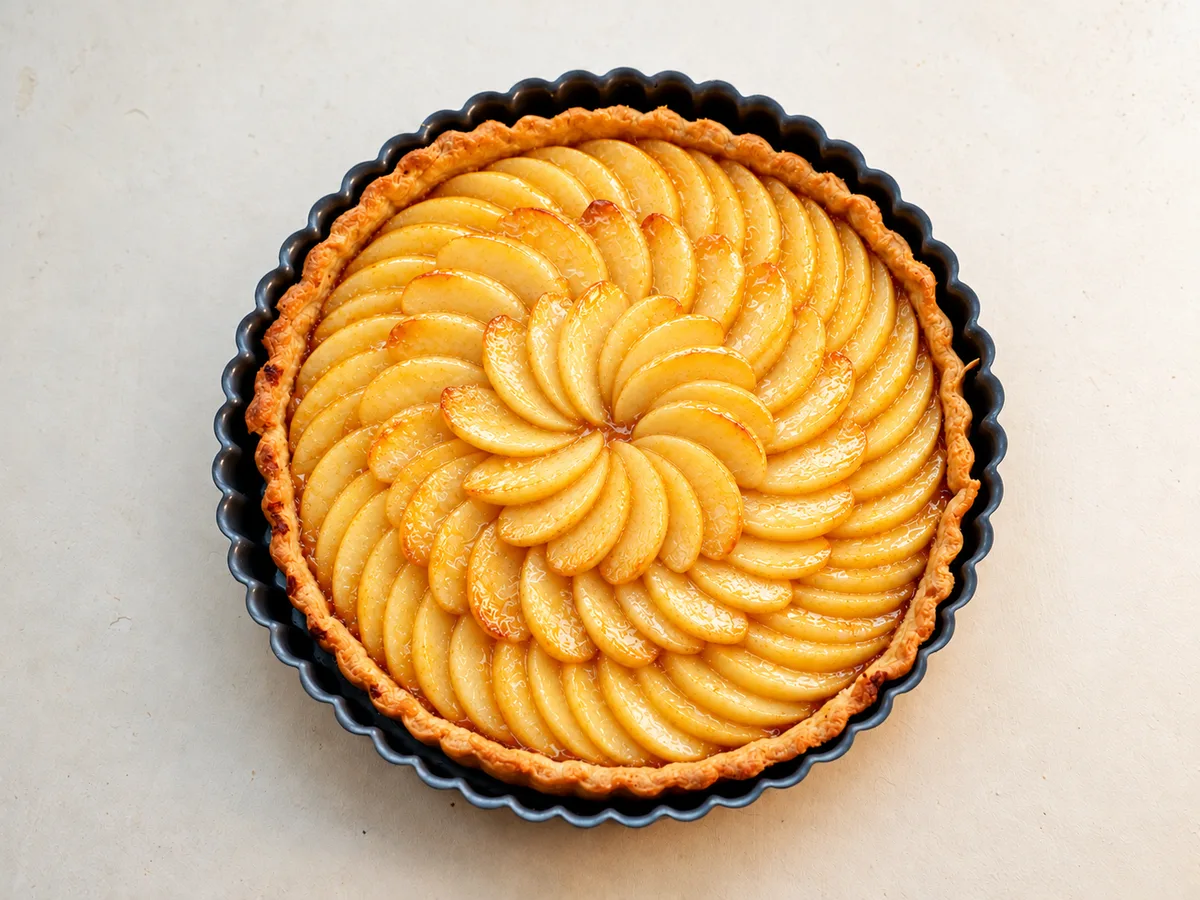
Across most of France, tarte aux pommes means a layer of compote under thin apple slices fanned in circles, brushed with apricot glaze. It's sweet, neat and firm enough to eat with your fingers. The Alsatian one swaps the compote and glaze for custard, so it's softer and eaten with a fork, and both start from the same butter shortcrust (the compote version is in the Notes).
Which apples go where?
You want wedges that go tender in the custard without turning to sauce.
Golden Delicious holds its shape and softens evenly. It's the one to buy.
Honeycrisp holds its wedges too but gives off more juice, which thins the custard, so give it the full first bake before the custard goes in.
Ambrosia keeps its shape, but it's sweet and mild, so add the lemon.
McIntosh collapses in the oven. Keep it for the compote version.
Two mistakes that spoil it
Pouring the custard over raw apples. Bake the apples in the crust first: they soften, give off some juice and the pastry sets, so the custard doesn't soak it.
Baking until the custard is firm. Take the tart out when the centre still wobbles a little; it sets as it cools, and overbaked custard turns grainy and weeps.
Making it in Canada
The 4 French ingredients, and what to buy for them in Canada.
Pommes Golden ou Reine des Reinettes→Golden Delicious apples, with a squeeze of lemon
Golden Delicious is the same variety French bakers use, and its wedges go tender in the custard without collapsing. Reine des Reinettes, the sharper French favourite, isn't sold in Canadian supermarkets; a little lemon juice on the wedges brings back some of its tang. Avoid McIntosh here: it turns to sauce.
🛒 Golden Delicious is in every supermarket all year. In September and October, orchards and farmers' markets sell many more varieties; any firm, tart-sweet apple works.
Crème fraîche ou crème liquide entière→35% whipping cream
French cooks make the custard with crème entière (about 30% fat) or crème fraîche. 35% whipping cream sets just as smooth and doesn't split in the oven; 10% or 15% cream gives a looser, watery custard. If you see crème fraîche, replace up to half the cream with it for a slight tang.
🛒 Lactantia 35% Whipping Cream at Sobeys-group stores, Sealtest 35% at Walmart. Liberté 40% crème fraîche, 250 mL, with the sour cream at Metro, IGA and Super C in Quebec and at Sobeys elsewhere, when it's in stock.
Sucre vanillé (1 sachet)→1 tsp pure vanilla extract
Alsatian recipes flavour the custard with a sachet of vanilla sugar. Pure vanilla extract, in every baking aisle, gives the same taste; avoid imitation vanilla, which you notice in a plain custard.
🛒 Club House Pure Vanilla Extract at Metro, Super C and Walmart; look for the word Pure on the label. Dr. Oetker Vanilla Sugar (9 g sachets) is at Metro and Walmart if you'd rather use the French way: one sachet replaces the extract.
A French pâte brisée is made with butter. Tenderflake frozen pie shells, the brand in most freezers, are made with lard or with vegetable shortening depending on the box, and they're deep pie shells, not a flat tart case. The butter pastry below takes 10 minutes plus 30 minutes in the fridge.
🛒 Ready-made butter puff suits the compote version better than this one, because the custard soaks it: PC Butter Puff Pastry (450 g) at Maxi in Quebec and Loblaws elsewhere, or Première Moisson pur beurre (400 g) at Metro.
Good to know: Buy the 473 mL carton of 35% cream: 200 mL goes into the custard, and the rest whips for serving.
Ready to cook?
French Apple Tart
Tarte aux pommes
A butter shortcrust filled with apple wedges, baked until they soften, then covered with a vanilla custard of eggs, cream and sugar and baked until just set. The Alsatian apple tart, made with Golden Delicious apples and Canadian 35% cream.
Prep time
30 min
Cook time
55 min
Resting time
1 hr 15 min
Total time
2 hr 40 min
Servings
8
Chill the pastry 30 minutes and the lined pan 15, then cool the baked tart at least 30 minutes so the custard sets.
Ingredients
Original recipe: 8 servings.
Instructions
Make the pastry. Mix the flour, sugar and salt. Rub in the butter with your fingertips until it looks like coarse crumbs. Add the yolk and 2 tbsp ice water and press together with a fork, adding the last spoon only if it's too dry to hold. Flatten into a disc, wrap and chill 30 minutes.
Line the pan. Roll the pastry 3 mm thick and line a 24 cm (9½ in) tart pan with a removable bottom. Prick the base with a fork and chill 15 minutes while the oven heats to 200°C (400°F), with a rack in the lowest position.
Arrange the apples. Toss the wedges with the lemon juice if your apples are mild. Lay them in the pastry in tight overlapping circles, rounded side up, starting from the outside. Sprinkle with 1 tbsp sugar and the cinnamon, if using.
Bake the apples. Bake on the lowest rack 25 minutes, until the edge of the pastry is pale golden and the apples are starting to soften at the tips.
Make the custard. While the apples bake, whisk the eggs, 60 g sugar and vanilla until the sugar dissolves, then whisk in the cream. Don't beat it frothy: the bubbles leave holes on top.
Add the custard. Lower the oven to 180°C (350°F). Slide the rack out, pour the custard between the apples until it comes almost to the rim, and slide the rack back in. Pouring in place saves carrying a full tart pan across the kitchen.
Bake until just set. Bake 25–30 minutes, until the custard is set at the edge, the centre still wobbles slightly when you nudge the pan, and the top has golden patches.
Cool. Cool on a rack at least 30 minutes before taking it out of the pan and slicing: the custard finishes setting as it cools.
Amazon links are affiliate links: as an Amazon Associate I earn from qualifying purchases, at no extra cost to you.
Notes
The compote version: skip the custard. Cook 500 g diced McIntosh apples with 30 g sugar and 2 tbsp water, covered, 10–15 minutes, then mash and cook uncovered until a spoon leaves a clear trail; cool it (or use about 300 mL unsweetened applesauce). Spread it over the raw pastry, cover with 600 g Golden Delicious or Cortland apples sliced 3 mm thick in overlapping circles, brush with 20 g melted butter, sprinkle with 1 tbsp sugar and bake 40–45 minutes at 200°C (400°F).
For the compote version's glaze, warm 3 tbsp apricot jam with 1 tbsp water, sieve it and brush it over the hot apples. Bonne Maman Apricot (250 mL) is at Metro and Walmart, Smucker's Pure Apricot (500 mL) at Walmart and Sobeys; avoid light fruit spreads, which don't melt into a clear glaze.
Make ahead: the pastry keeps 2 days in the fridge. You can also freeze the lined pan for up to a month and fill it straight from the freezer; add 5 minutes to the first bake.
No tart pan? Use a 23 cm (9 in) glass pie plate and add 5–10 minutes to the first bake; lift the edge of a wedge to check the base is golden.
Best the day it's baked, at room temperature or lightly chilled. Because of the custard, refrigerate it, covered, within 2 hours of cooling; it keeps 2 days. Serve plain or with a spoon of whipped cream.
Course: Desserts · Cuisine: French · Adapted for Canadian kitchens
Made this? Send it to whoever you're cooking for next, or pin it for later.
Most frozen puff pastry in Canada is made with margarine, not butter: fine for cheese straws, flat in a galette des rois. Which blocks contain butter, why pâte brisée is worth making yourself, and quick brisée, sablée and rough puff.