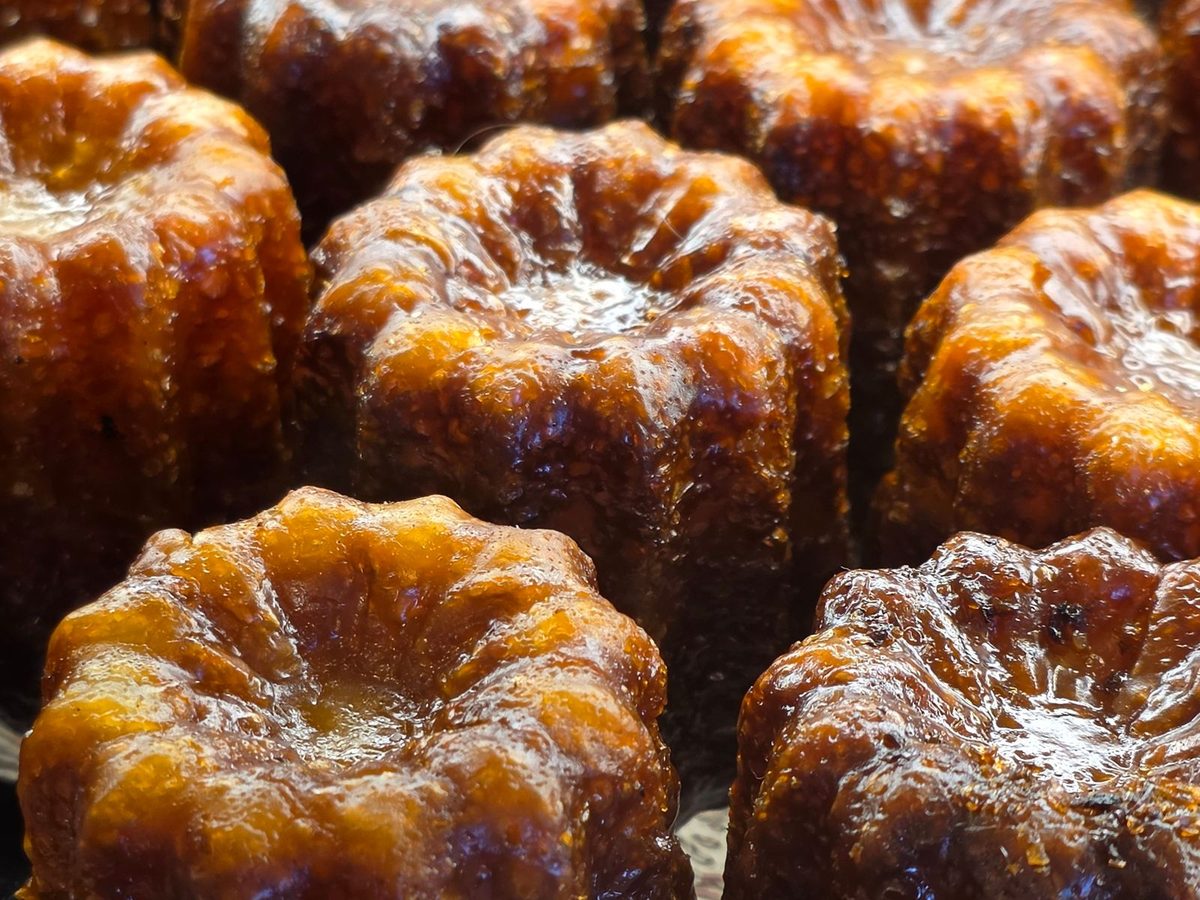
Small Bordeaux cakes with a dark caramelized crust and a soft, custardy centre that tastes of vanilla and rum. The batter takes 15 minutes to make but rests overnight in the fridge, so make it the day before you bake.
Before I moved to Canada, cannelés were easy to take for granted: in France you find them in plenty of bakeries, not just in Bordeaux. Here they're much harder to come by, usually only at French pâtisseries. So they joined the list of French things I make at home.
A black shell with a custard inside
A cannelé is a small fluted cake from Bordeaux, about 5 cm tall. The outside is a thin caramel shell, close to black on the ridges, that crackles when you bite it; the inside is soft and moist, nearer to a set custard than a cake, and tastes of vanilla and rum. In France you eat one with a coffee, or as an afternoon goûter.
Which mould to buy in Canada
Cannelés need tall fluted moulds about 5.5 cm wide, and Canadian supermarkets don't sell them next to the muffin pans. The moulds are the hard part, so here are the three choices:
Tin-lined copper is the Bordeaux standard. It heats fast and evenly and gives the darkest, crunchiest shell, but the moulds are sold one at a time, mostly by French shops that ship here, so a full set costs hundreds of dollars once shipping and duties are added.
A 12-cup non-stick carbon steel tray costs far less and still gives a dark, crisp crust. My pick is the CHEFMADE 12-cavity tray on Amazon.ca. It bakes this batter in two rounds.
Silicone is the cheapest and unmoulds easily, but the crust stays pale and soft. I'd skip it.
The bake does the work
The batter is a sweet crêpe batter, ready in 15 minutes, and then it rests at least overnight. A pale cannelé is an underbaked one: a hot start sets the outside, then close to an hour at a lower heat turns the crust deep mahogany. With a 12-cup tray that's two rounds, so plan on about 2 hours 40 minutes of oven time.
Making it in Canada
The 4 French ingredients, and what to buy for them in Canada.
Farine T45 ou T55→All-purpose flour
French recipes use T45 or T55, around 9.5–11% protein. Canadian all-purpose is stronger, about 13% on the label, but in a thin batter that you stir gently and rest overnight it works fine. Don't use bread flour: the cannelés turn rubbery.
🛒 Five Roses All Purpose at Super C and Walmart, or Robin Hood Original All Purpose at Sobeys and Walmart. Both list about 13% protein.
In France, sucre en poudre means ordinary granulated sugar, not powdered sugar. Some cannelé recipes call for sucre glace (icing sugar), but Canadian icing sugar has cornstarch added, so stick with granulated.
Gousse de vanille→2 tsp pure vanilla extract
A Bordeaux baker infuses a split bean in the milk. Beans are sold here, but they're pricey, and 2 tsp of pure extract, stirred in with the rum, gives the batter the same vanilla backbone. Add extract after heating, not to the hot milk, or some of the flavour cooks off.
🛒 Club House Pure Vanilla Extract, 46 mL or 125 mL, at Metro, Super C, Maxi and Walmart. Check for the word "Pure": the 43 mL Club House bottles are imitation.
Moules à cannelés en cuivre→12-cup non-stick carbon steel cannelé tray
Copper gives the darkest shell, but a full set is a big import order. A non-stick carbon steel tray gets close to that crust for far less; it just means two batches and a slightly cooler first bake.
🛒 CHEFMADE 12-cavity non-stick canelé pan (model WK9158) on Amazon.ca. Don't confuse it with the CHEFMADE mini canelé pan, which makes much smaller cakes.
Good to know: Order the tray before you make the batter: it's the one thing you can't pick up on the way home. The rum comes from the liquor store: an amber or dark rum, not spiced.
Ready to cook?
Cannelés
Cannelés de Bordeaux
Small Bordeaux cakes with a dark caramelized crust and a soft, custardy centre that tastes of vanilla and rum. The batter takes 15 minutes to make but rests overnight in the fridge, so make it the day before you bake.
Prep time
20 min
Cook time
2 hr 40 min
Resting time
14 hr
Total time
17 hr
Servings
9
Allow at least 12 hours for the batter in the fridge, 1 hour at room temperature before baking, and 1 hour of cooling after the last batch. The 2 hr 40 min cook time covers both batches and resetting the 12-cup tray. The first batch cools while the second bakes. With the preferred 24-hour batter rest, allow 29 hours total.
Ingredients
Original recipe: 9 servings.
Instructions
Warm the milk. Put the milk, 50 g butter and, if you're using one, the vanilla seeds and scraped pod in a saucepan. Heat over medium until small bubbles appear around the edge and the butter has melted, then take it off the heat and let it cool for 10 minutes.
Make the paste. In a large bowl, stir the sugar, flour and salt together. Add the eggs and yolks and stir with a spatula or whisk until you have a thick, smooth paste. Stir, don't whip: air bubbles make cannelés puff up out of the moulds.
Add the milk and rum. Pour in the warm milk a little at a time, stirring as you go, until the batter is smooth and thin like crêpe batter. Stir in the rum, and the vanilla extract if you're using it.
Rest the batter overnight. Strain the batter through a sieve into a container. If you used a vanilla bean, put the pod back in. Press plastic wrap onto the surface and refrigerate at least 12 hours, ideally 24. The rest lets the flour soak up the liquid and the bubbles settle out, which gives a smooth custard inside and stops the cannelés from rising like muffins.
Prepare the moulds. Take the batter out of the fridge an hour before baking and remove the vanilla pod, if there is one. Heat the oven to 220°C (425°F) with a rack in the lower third; a non-stick tray isn't made for more. Brush the moulds with a thin coat of melted butter, into every ridge, and put them in the freezer for 10 minutes so the butter sets.
Fill the moulds. Stir the batter gently from the bottom, since the flour and sugar settle while it rests. Fill each mould to about 1 cm (⅜ in) below the rim. Set silicone moulds on a baking sheet; a metal tray goes straight on the rack.
Bake hot, then lower. Bake 15 minutes at 220°C (425°F). If the cannelés rise more than 1 cm above the moulds, pull the tray out for a minute so they sink back, then return it. Turn the oven down to 190°C (375°F) and bake another 50–60 minutes, until the exposed tops are dark brown.
Check and unmould. Unmould one cannelé onto a rack. The sides should be deep mahogany all over, almost black on the ridges. If they're pale or patchy, put it back and bake the tray 5–10 minutes more. Then unmould them all while hot by tapping the tray on the counter.
Bake the second batch. Let the tray cool until you can handle it, wipe it out, brush it with butter again and freeze it for 10 minutes while the oven goes back up to 220°C (425°F). Stir the batter from the bottom, fill and bake exactly as before.
Cool. Let the cannelés cool at least 1 hour on the rack. The inside is still setting when they come out of the oven, and the crust crisps as it cools.
Equipment
CHEFMADE 12-cup cannelé pan: Non-stick carbon steel gives a much darker, crisper crust than silicone. This 12-cup tray bakes the batch in two rounds and is rated to 220°C (425°F), the temperature this recipe starts at.
Amazon links are affiliate links: as an Amazon Associate I earn from qualifying purchases, at no extra cost to you.
Notes
Makes about 15 to 18 cannelés in 5.5 cm moulds, baked in two rounds in a 12-cup tray: enough for 9 people at two each.
The batter keeps up to 4 days in the fridge. If you have the time, wait 2 or 3 days before baking: the inside gets even smoother.
If a cannelé comes out with a pale, flat top (bakers call it a "cul blanc"), it rose out of the mould and lost contact with the hot metal. Fill a little lower and stir the batter more gently next time.
In copper or uncoated steel moulds, which take more heat than a non-stick tray, you can start at 230°C (450°F) for the first 15 minutes for an even darker shell.
Cannelés are best the day they're baked. Don't refrigerate them: the crust turns soft and chewy. If they've softened by the next day, 5 minutes in a 200°C (400°F) oven crisps them again.
Course: Baking · Cuisine: French · Adapted for Canadian kitchens
Made this? Send it to whoever you're cooking for next, or pin it for later.