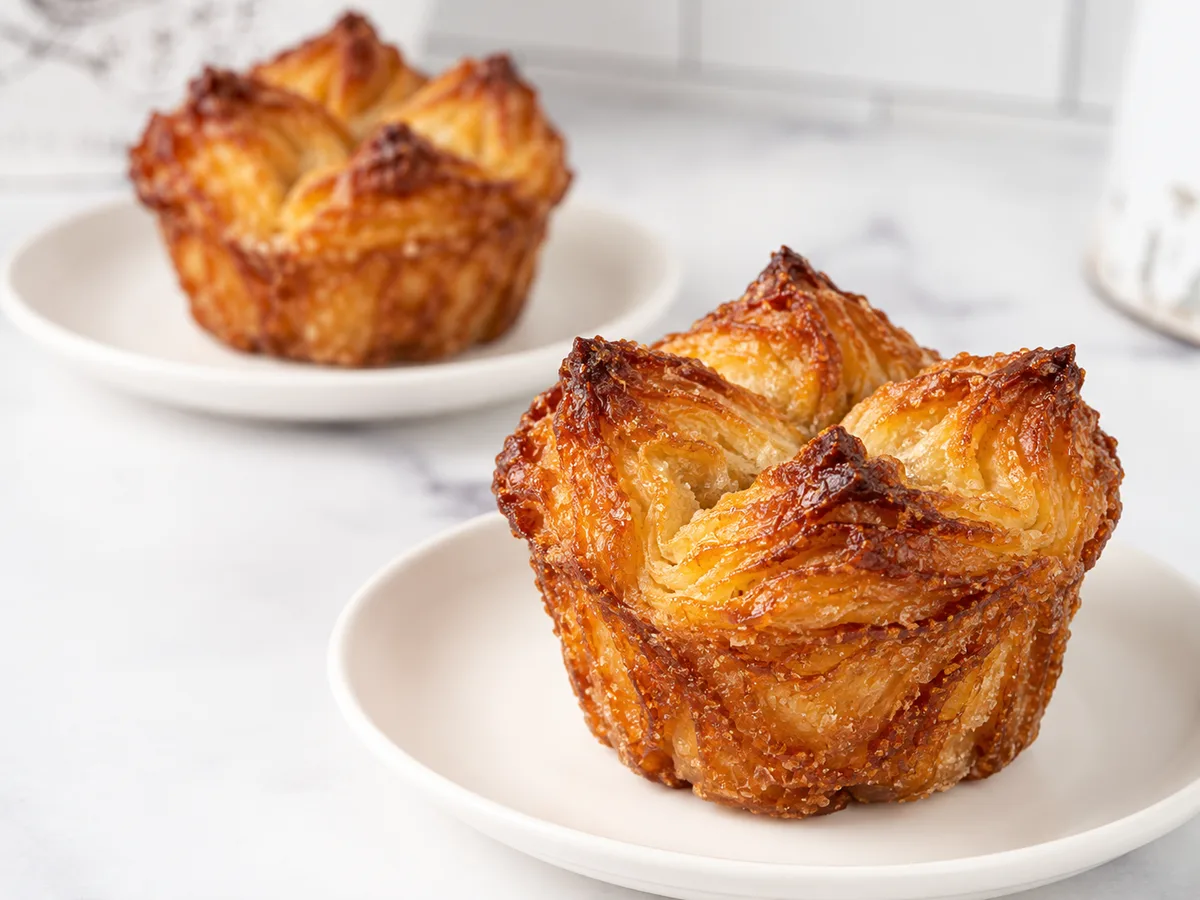
Breton bread dough folded with salted butter and sugar, baked in a muffin tin until the outside turns to crackly caramel and the inside stays soft and layered. Made with Canadian all-purpose flour and the firmest salted butter you can find.
Some Canadian bakeries carry kouign-amann, so if you just want one with a coffee, ask at a French-style bakery near you first. If there isn't one, they're worth making at home. The butter is the big difference here and the flour the small one: Canadian all-purpose is stronger than French T55, so the dough fights back when you roll it. A 10-minute rest in the fridge settles it, and the caramel crust bakes up just as dark and crackly.
Kouign-amann is bread dough folded with salted butter and sugar, about twice as much dough as butter or sugar, then baked until the sugar turns to a dark, crackly shell. The name is Breton for butter cake. It's a weekend project, about four hours with most of it in the fridge, and the steps below keep it manageable.
One big cake or twelve small ones?
In Douarnenez, in Brittany, kouign-amann is one large round cake, cut in wedges. The individual ones baked in a tin are the modern bakery version, and they're easier at home: the caramel forms all around each one, and a standard 12-cup muffin tin does the job.
Which butter holds its layers
Canadian butter is 80% fat, a little softer and wetter than the butter French bakers use, and soft butter breaks through the dough when you roll it. A European-style salted butter at 81–82% stays in sheets.
The sugar turns make the dough wet
In the last two folds, the sugar draws water out of the dough, and it gets sticky and glossy. That's expected, not a mistake. Work quickly, dust with a little flour only where it sticks, and get it back in the fridge.
Making it in Canada
The 2 French ingredients, and what to buy for them in Canada.
Beurre demi-sel→European-style salted butter (81%), or regular salted butter with longer chilling
Regular Canadian butter is 80% fat and softer when cold, so it smears into the dough instead of staying in a sheet. An 81–82% European-style butter is firmer and gives cleaner layers. With regular butter, chill 45 minutes between folds instead of 30 and keep the kitchen cool.
🛒 Lactantia European Style Salted Butter (81%) comes in a 250 g block, enough for this recipe. It's listed at Sobeys; elsewhere, look for 'European style' and 81% or 82% M.F. on the label in the butter case. Lactantia and Gay Lea regular salted butter (454 g) are the everyday fallback.
French T55 is around 10–11% protein. Canadian all-purpose is about 13%, which makes a stretchier dough that holds the butter well but fights back when you roll it. If it springs back, rest it 10 minutes in the fridge and try again rather than forcing it.
🛒 Robin Hood All Purpose and Five Roses All Purpose both list about 13% protein. Both are at Walmart and Sobeys; Five Roses is also at Super C.
Good to know: European-style butter is often easier to find unsalted (Lactantia European Style Unsalted, 82%, 250 g, is listed at Sobeys/Voilà). If that's the one you find, use it and add 4 g (¾ tsp) more fine salt to the dough.
Ready to cook?
Kouign-Amann
Breton bread dough folded with salted butter and sugar, baked in a muffin tin until the outside turns to crackly caramel and the inside stays soft and layered. Made with Canadian all-purpose flour and the firmest salted butter you can find.
Prep time
1 hr
Cook time
30 min
Resting time
3 hr
Total time
4 hr 30 min
Servings
12
About 1 hour for the dough to rise, 1½ hours of chilling between folds (2¼ hours with regular butter), and 30 minutes of proofing in the tin.
Ingredients
Original recipe: 12 servings.
Instructions
Make the dough. Mix the flour, yeast, salt and water and knead 8 minutes, until smooth. Cover and leave about 1 hour, until doubled.
Prepare the butter. Put the cold butter between two sheets of parchment and beat it with a rolling pin into a 15 cm square, about 1 cm thick. Keep it in the fridge until the dough is ready.
Enclose the butter. Press the dough flat and roll it into a 25 cm square. Put the butter in the middle, turned like a diamond, fold the corners of the dough over it and pinch the seams to seal.
First fold. Roll into a rectangle about 45 × 20 cm and fold it in three like a letter. Wrap and chill 30 minutes, or 45 minutes with regular butter.
Second fold, with sugar. Roll out again to about 45 × 20 cm, sprinkle with half the sugar, press it in lightly with the pin and fold in three. Work quickly: the sugar draws water out of the dough and makes it sticky. Dust with a little flour only where it sticks, then wrap and chill 30 minutes (45 with regular butter).
Third fold, with sugar. Repeat with the rest of the sugar, working just as quickly. Wrap and chill 30 minutes more (45 with regular butter).
Shape. Butter a 12-cup muffin tin and sprinkle the cups with sugar. Roll the dough into a 30 × 40 cm rectangle and cut it into twelve 10 cm squares. Fold the four corners of each square to the centre and press it into a cup.
Proof. Cover and leave 30 minutes, until slightly puffy. Heat the oven to 200°C (400°F) and put a baking sheet on the rack below to catch drips.
Bake. Bake 25–30 minutes, until deep amber all over. Pale kouign-amann stays sticky and soft; it needs the colour to crunch. If the caramel at the edges is going from amber to black before the centres colour, lower the oven to 190°C (375°F) for the last 5 minutes.
Unmould hot. Turn them out straight away onto a rack lined with parchment, using a small knife to free any that stick. Let cool 15 minutes before eating.
Amazon links are affiliate links: as an Amazon Associate I earn from qualifying purchases, at no extra cost to you.
Notes
Makes 12, one per person.
Best the day they're baked. Reheat leftovers 5 minutes at 180°C (350°F) to crisp the caramel.
If butter breaks through the dough while you roll, dust the spot with flour and chill 15 minutes longer before the next fold.
The shaped kouign-amann can wait overnight in the fridge, covered. Bake them straight from cold, adding 5 minutes.
Caramel stuck in the tin softens if you fill the cups with hot water and leave them 10 minutes.
For one large Breton-style cake, shape the dough into a 24 cm round after the last fold, set it in a buttered, sugared 24 cm cake pan and bake about 40 minutes at 200°C (400°F), until deep amber. Cut it in wedges once it's just warm.
Course: Baking · Cuisine: French · Adapted for Canadian kitchens
Made this? Send it to whoever you're cooking for next, or pin it for later.