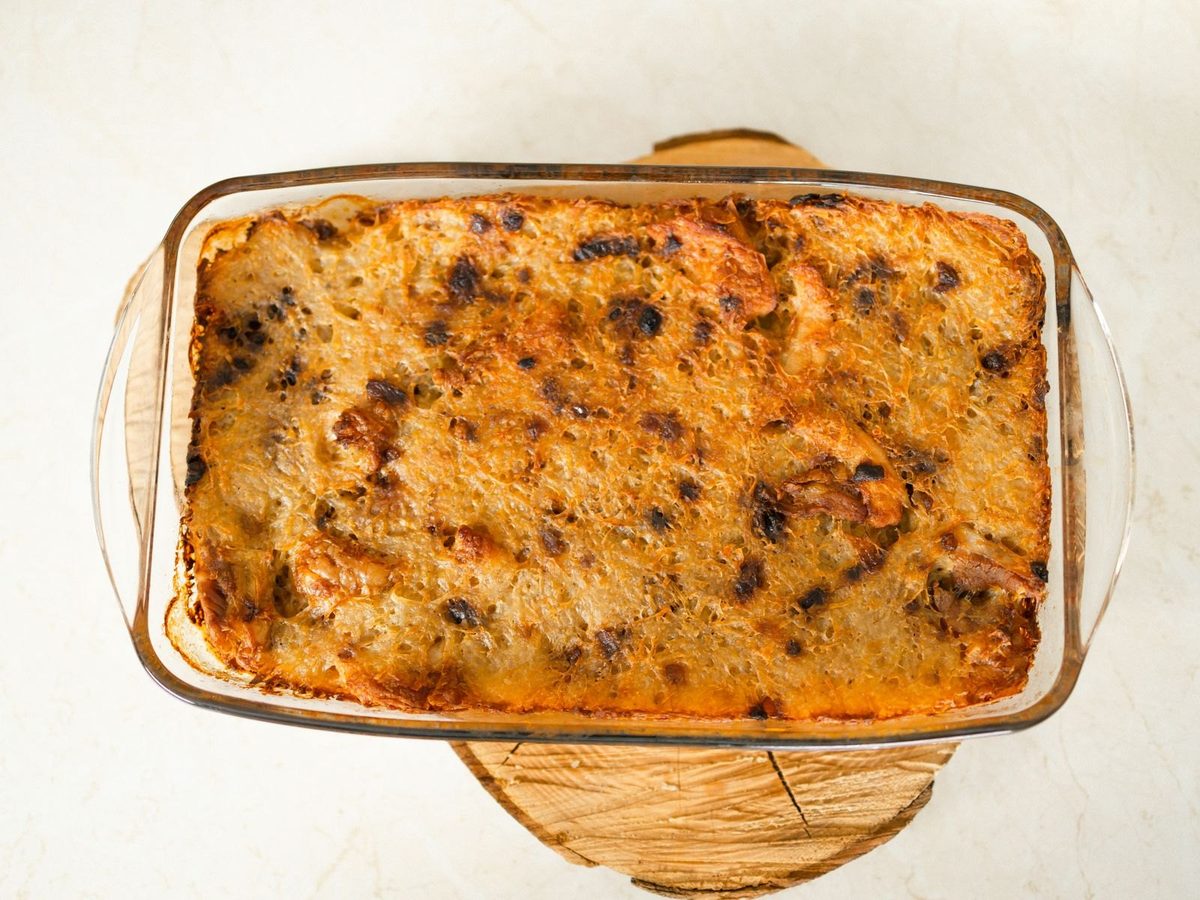
Thick slices of stale bread soaked in sweet vanilla milk and egg, then browned in butter with a little sugar until caramelized outside and custardy inside. The French way to save yesterday's baguette, made with day-old Canadian bread.
French toast in Canada comes with maple syrup at breakfast. In France, pain perdu is an afternoon snack or a dessert, caramelized in the pan, and it is the best use I know for bread that has gone hard.
What is pain perdu?
Pain perdu means lost bread: bread too stale to eat, saved by soaking it in milk, egg and sugar and frying it in butter. A last sprinkle of sugar in the pan turns into a thin crackly caramel. It is eaten warm for the goûter or after dinner, on its own or with fruit.
Which Canadian bread works
The bread has to be stale. Fresh bread soaks up the milk and falls apart in the pan. What works here:
A day-old baguette from the supermarket bakery, cut thick on the diagonal.
Day-old brioche or challah, for a richer, softer version.
A country or Italian loaf, sliced 2 cm thick and left out overnight.
Soft sliced sandwich bread is too thin and too soft: it turns to mush.
Making it in Canada
The 3 French ingredients, and what to buy for them in Canada.
Pain rassis (baguette de la veille)→Day-old supermarket baguette, brioche or challah
Stale bread soaks up the custard without falling apart. Leave slices out on a rack overnight if your bread is still fresh.
Good to know: A supermarket bakery baguette left out for a day is ideal. If yours is still soft, dry the slices in a 120°C (250°F) oven for 10 minutes before soaking.
Ready to cook?
French Toast
Pain perdu
Thick slices of stale bread soaked in sweet vanilla milk and egg, then browned in butter with a little sugar until caramelized outside and custardy inside. The French way to save yesterday's baguette, made with day-old Canadian bread.
Prep time
10 min
Cook time
15 min
Total time
25 min
Servings
4
Ingredients
Original recipe: 4 servings.
Instructions
Make the custard. In a wide, shallow dish, whisk the eggs, milk, 40 g sugar, vanilla and salt until smooth.
Soak the bread. Lay the slices in the custard and soak 20–60 seconds per side, depending on how dry the bread is, until soaked through but not falling apart.
Heat the pan. Melt half the butter in a large non-stick frying pan over medium heat until it foams.
Brown the slices. Cook the slices 2–3 minutes per side, until deep golden and the centre feels set when pressed, not wet. Don't raise the heat: the outside browns before the middle cooks.
Caramelize. Sprinkle a little sugar over the top of the slices, flip them and cook 30 seconds more, until the sugar melts into a thin caramel. Repeat with the rest of the butter and bread.
Serve. Serve straight away, while the caramel still crackles.
Notes
Keep the first batch warm in a 100°C (200°F) oven while you cook the rest.
Wipe out the pan between batches if the butter starts to burn, then add fresh butter.
Leftover custard keeps a day in the fridge; it won't keep longer because of the raw egg.
Course: Desserts · Cuisine: French · Adapted for Canadian kitchens
Made this? Send it to whoever you're cooking for next, or pin it for later.
Lait entier is 3.25% milk, labelled homo or lait 3,25 %. Demi-écrémé is closest to 2%. What changes in crêpes and custards when you only have 2%, plus lait ribot, babeurre and lait concentré on Canadian shelves.